Photographing mountain gorillas in Rwanda

The forest is darker than photographers expect, the hour goes faster than anyone believes, and flash is forbidden. Those three facts decide almost every equipment and settings decision for photographing mountain gorillas in Volcanoes National Park.

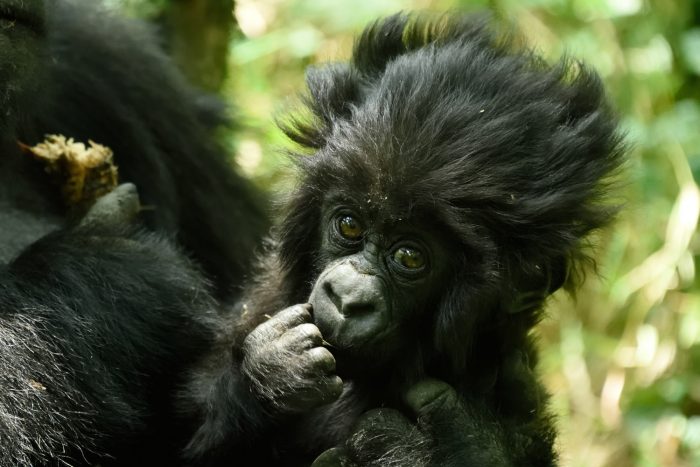
A young mountain gorilla in dense vegetation, Volcanoes National Park, Rwanda

At a glance

Light level
Deep shade under canopy; often 1/60s at f/2.8 and ISO 3200
Best lens
24–70mm equivalent; 70–200mm as a second body
Flash
Strictly prohibited
Distance
About 7 metres, though gorillas often come closer
Time with the family
One hour
Essential extras
Rain cover, lens cloths, spare batteries, dry bag
Porter
Strongly recommended — carries the bag, frees your hands

Lens choice — go wider than you think

Most first-time visitors bring a long telephoto and end up unable to use it. Gorillas frequently sit within a few metres of you, and a 400mm lens simply cannot frame them. A 24–70mm on a full-frame body handles the great majority of usable shots, and a wide 16–35mm captures the far better photograph: a gorilla in its forest, with the tangle of bamboo and Hagenia around it.

If you carry a second body, put a 70–200mm on it for portraits and juveniles higher in the trees. Changing lenses in wet forest with an eight-person group moving around you is not realistic — two bodies or one versatile zoom.

Settings for very low light

Work in aperture priority at f/2.8 to f/4, auto-ISO with a ceiling of 6400 or higher on a modern body, and a minimum shutter speed of 1/125s — gorillas move suddenly and infants never stop. Accept the noise; a slightly grainy sharp frame beats a clean blurred one every time.

Spot or centre-weighted metering stops the dark fur from being underexposed against bright leaf gaps. Dial in a little positive exposure compensation and check the histogram once, early, rather than chimping through the hour.

Rain, mud and the practical side

Assume rain in any month. A proper rain cover for the camera, a dry bag inside your daypack, several microfibre cloths and two spare batteries — cold at altitude drains them — are the whole kit list. Silica gel in the bag helps on green-season trips.

Book a porter. They carry the bag up, hand you the camera when you arrive, steady you on descents and know exactly where to stand. It costs very little and the money goes straight into households on the park boundary.

Using the hour

Spend the first two minutes without the camera at your eye. Watch where the silverback is, where the infants are playing, and where the light is falling. Then shoot deliberately: a wide environmental frame, a portrait, hands and feet, an interaction between two animals, and one frame that includes the forest floor to give a sense of place.

Flash is prohibited, and no one should have to ask you twice. If photography is central to your trip, take two permits on consecutive days — the first hour teaches you the light, the second is when you actually make the photograph. Guests who want no other group present can arrange an exclusive private family visit at USD $15,000.

— Questions

Photographyanswered

What lens is best for gorilla trekking photography?

A 24–70mm equivalent handles most of the hour, with a 16–35mm for environmental frames. Gorillas often come within a few metres, so long telephotos are frequently too tight to use.

Can I use flash when photographing gorillas?

No. Flash is strictly prohibited in Volcanoes National Park. Plan for high ISO and fast glass instead.

Should I bring a tripod?

No. There is no room, no time and no need — you will be hand-holding in dense vegetation. A monopod is occasionally useful on the walk but rarely during the hour itself.

Is one hour enough for good photographs?

It is enough for good photographs and rarely enough for the photograph you imagined. Photographers who take two permits on consecutive days come home with markedly better work.

— Bespoke Composition

Tailor your journey.

Tell us a little about how you travel. Our team will reply within 24 hours with a draft itinerary composed for you alone.

Private expeditions are typically composed from USD $10,500 per guest, fully inclusive of gorilla permits, lodging, guiding and transfers.

Curated by Gerry
Have questions first? See our Journey Guide