How Difficult Is
Gorilla Trekking?
Honest trek times, altitude, family-by-family difficulty grades and a six-week preparation plan — so you arrive at Kinigi knowing exactly what the day asks of you.
Moderate. If you can walk uphill for two hours without stopping, you can trek gorillas in Rwanda.
A gorilla trek in Volcanoes National Park is a walk, not a climb. You hike between 2,500 and 3,700 metres on uneven volcanic ground, often wet, with steep sections and no established path once you leave the buffer zone. Trek times run from 45 minutes to 6 hours each way — the average is 2 to 3 hours.
Two things make it far easier than the numbers suggest. First, there is no schedule: the ranger sets the pace to the slowest person in your group of eight, and nobody is left behind. Second, porters. For USD $20 a porter carries your daypack, takes your hand on the steep ground, and turns a hard morning into a manageable one.
Rwanda's forest is also kinder than its reputation. The bamboo and hagenia woodland of the Virungas is open and firm underfoot compared with the dense undergrowth of Uganda's Bwindi — one of several reasons we recommend Rwanda for anyone unsure about their fitness.
Not all treks are the same trek
Volcanoes National Park has 12 habituated gorilla families, and the difference between the easiest and the hardest is several hours of climbing. Families are allocated at the 07:00 briefing at Kinigi headquarters, and this is where your guide earns their keep: we brief the RDB wardens on your group's fitness before allocation. Families roam, so these are typical rather than guaranteed.
Easier groups
Kwitonda, Igisha, Muhoza
- 45 minutes – 2 hours each way
- 2,500 – 2,800 m
- Gentle to moderate
- First-time trekkers, travellers over 65, anyone with knee or hip concerns, families with children of 15+
Moderate groups
Amahoro, Ugyenda, Hirwa
- 2 – 3.5 hours each way
- 2,700 – 3,100 m
- Moderate, sustained climbing
- Most reasonably active travellers who walk regularly at home
Demanding groups
Susa, Karisimbi (Bwenge)
- 4 – 6 hours each way
- 3,000 – 3,700 m
- Strenuous — steep, muddy, high
- Hikers with genuine hill fitness who want the wildest possible trek
A six-week plan that is genuinely enough
6 weeks out
Walk 30–45 minutes, four times a week. Add a hill or a stairwell if you have one. The trek is about sustained uphill effort rather than speed.
4 weeks out
Extend one walk each week to 90 minutes on uneven ground. Break in the boots you intend to wear — blisters end more treks than fitness does.
2 weeks out
Do one 2–3 hour hike with a small daypack. If you use trekking poles, practise with them on a descent; the way down is where most people struggle.
Arrival
Sleep at lodge altitude (around 2,300–2,600 m) for a night before you trek. Drink more water than feels necessary and skip the long-haul-flight nightcap.
What the morning actually looks like
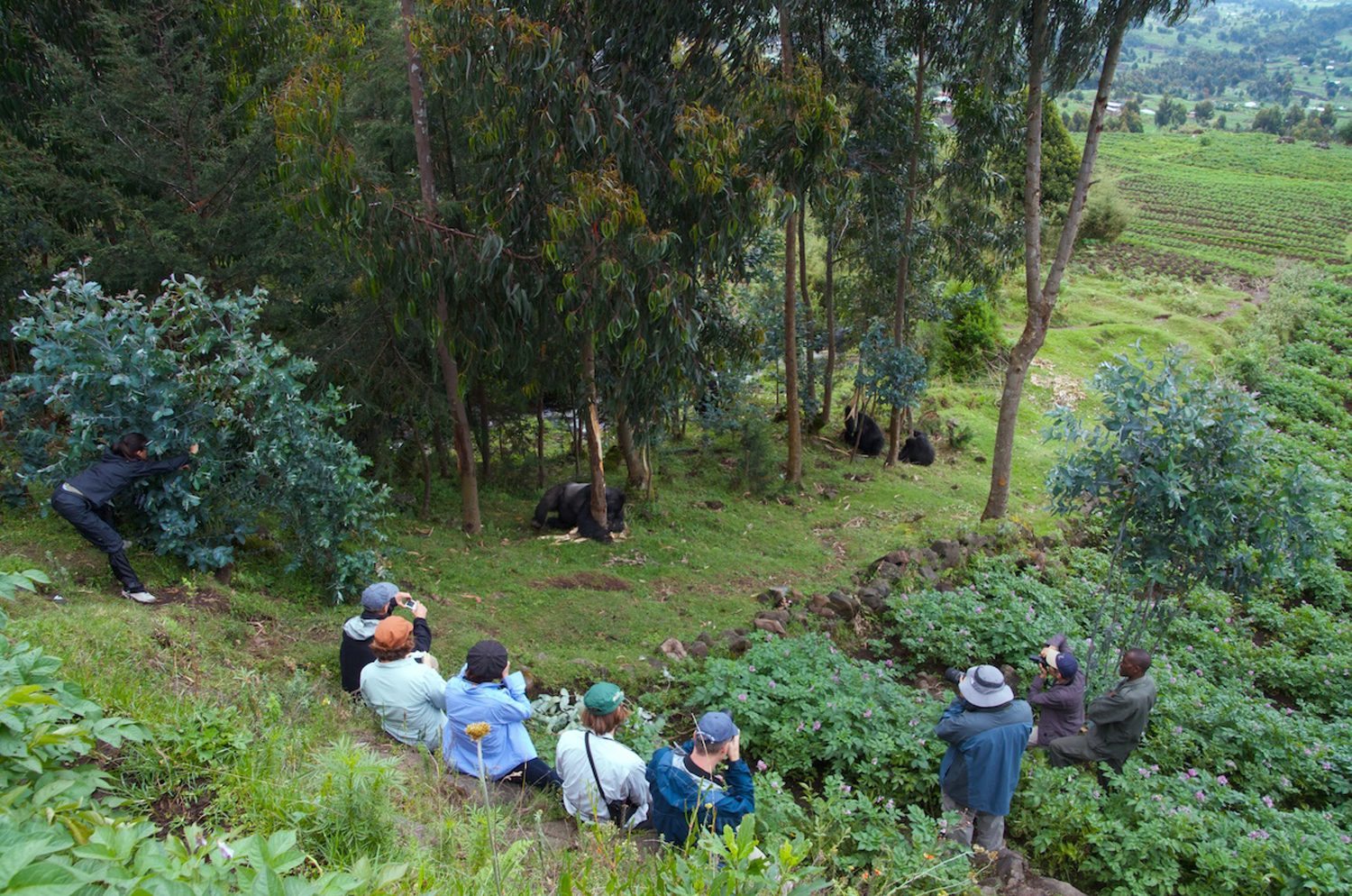
Breakfast at your lodge. Every activity in Volcanoes National Park starts in the morning, so this is not negotiable — but the volcanoes at dawn are worth it.
Briefing at Kinigi park headquarters. Traditional Intore dancers, a coffee, and family allocation. This is where we advocate for the right group for your party.
Drive to the trailhead — 15 to 45 minutes on rough track, in your private vehicle. Hire your porter here.
Walk through farmland and the buffer wall, then into the bamboo. The trackers have been with your family since dawn and radio their position through.
You reach the gorillas. Daypacks and poles are left with the porters, and the clock starts: exactly one hour, at seven metres' distance, with a family that has been habituated for decades.
Back at the trailhead, certificates are handed out. Most people are at their lodge by mid-afternoon, deeply tired and unable to stop talking.
If a steep trek is out of reach
Tell us before you book, not at the briefing. With notice we can request one of the lower, closer families and arrange a sedan chair — a sturdy seat carried by a team of porters — for roughly USD $300–500 depending on the distance. It has taken travellers in their eighties, and travellers recovering from surgery, all the way to the gorillas.
Two porters each is also a good decision for anyone unsteady on descents. And if a family is reallocated to a harder group on the day, your guide can ask the warden to reconsider — that conversation is much easier when we have flagged it in advance.
Difficulty & Fitness FAQ
How difficult is gorilla trekking in Rwanda?+
Moderate for most people. You hike between 2,500 and 3,700 metres on uneven volcanic ground with steep sections, for anywhere from 45 minutes to 6 hours each way depending on which family you are assigned. There is no time limit and no set pace — the group walks as slowly as its slowest member. Travellers in their 70s complete the trek regularly.
How hard is gorilla trekking if I am not fit?+
It is manageable. Tell us honestly about your fitness when you book and we request one of the closer, lower-altitude families for you at the morning briefing at Kinigi. Hire a porter (USD $20), take trekking poles, and walk slowly. If a very steep trek is genuinely out of reach, a sedan chair carried by a team of porters can be arranged in advance for roughly USD $300–500.
How long is the gorilla trek?+
Between 45 minutes and 6 hours of walking each way, plus the fixed one hour with the gorillas. Most treks land at 2–3 hours each way. The gorillas move overnight, so the exact distance is only known once the trackers radio in on the morning of your trek.
What is the minimum age for gorilla trekking in Rwanda?+
15 years old. Golden monkey trekking, also a morning activity in Volcanoes National Park, has a minimum age of 12 years old.
Is altitude sickness a risk on a gorilla trek?+
Serious altitude sickness is uncommon below 3,000 metres, and most treks stay under that. On the highest families, such as Susa or Karisimbi, mild headaches and breathlessness do occur. Spending a night at lodge altitude before trekking, drinking plenty of water, and keeping an easy pace deals with it in almost every case.
Should I hire a porter?+
Yes — always. Porters cost USD $20, carry your daypack, and give you a hand on steep or muddy ground. Many are former poachers now earning a living from conservation, so the fee is one of the most direct contributions you can make to the communities around the park. Budget an additional USD $10–15 as a tip.
What happens if I cannot finish the trek?+
A ranger escorts you back to the trailhead and you can wait for your group. Permits are not refunded once the trek has started, which is the main reason we spend time matching you to the right family in the first place.
What should I wear for gorilla trekking?+
Waterproof hiking boots with ankle support, long trousers tucked into thick socks, a long-sleeved shirt, gardening or trekking gloves for gripping vegetation, and a light waterproof jacket. Rain is possible in every month. Gaiters are worth packing in the wet season.
Tailor your journey.
Tell us a little about how you travel. Our team will reply within 24 hours with a draft itinerary composed for you alone.
Private expeditions are typically composed from USD $10,500 per guest, fully inclusive of gorilla permits, lodging, guiding and transfers.